
What is Python? – Introduction to Python Programming
About Python
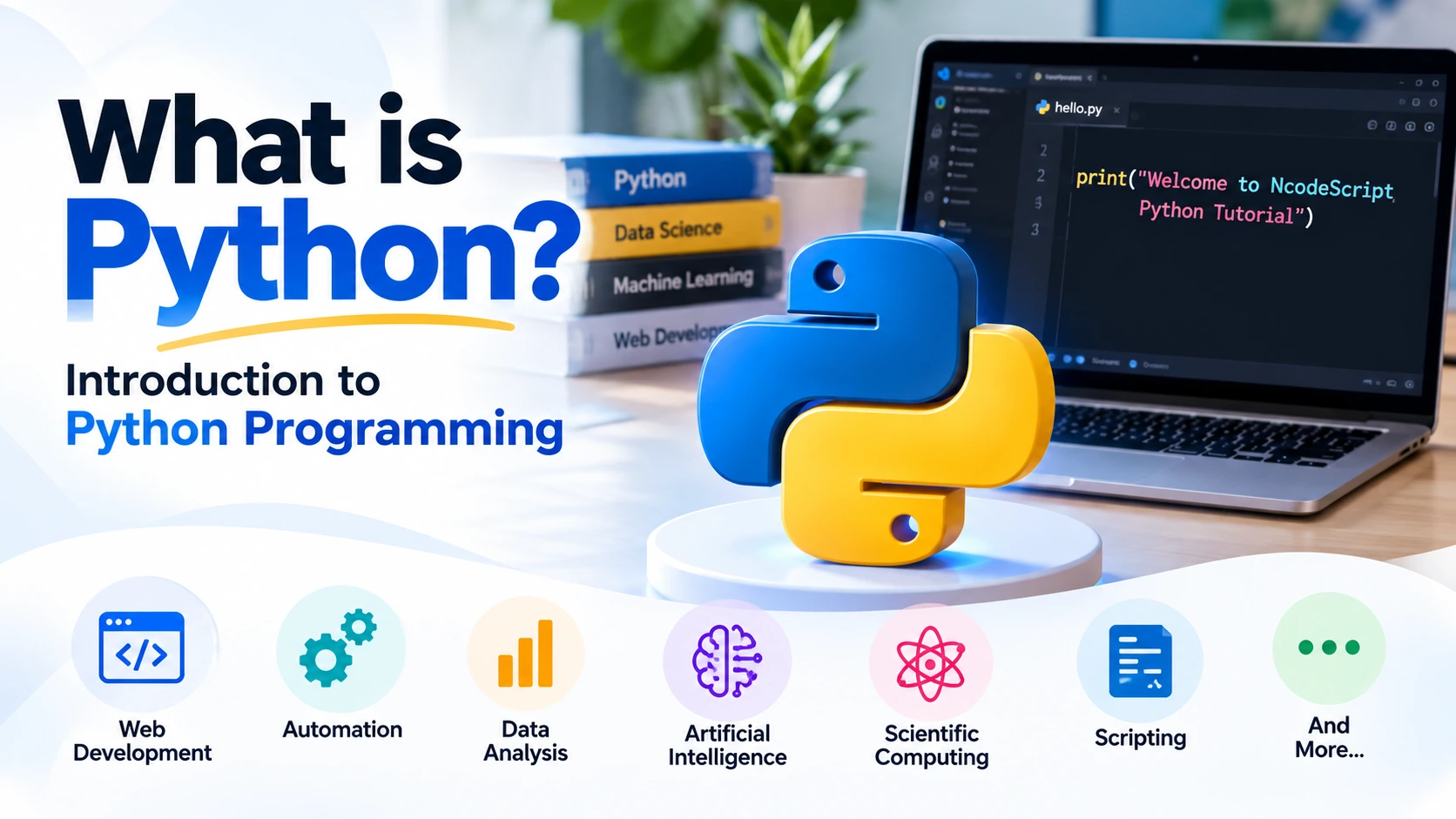
Python is a general purpose programming language and can be used to develop a variety of programs. It is not limited to one field. Developers use Python for developing websites, automation, data analysis, artificial intelligence, scientific computing, scripting and much more.
Python is free and open source. It works on all major operating systems including Windows, Linux and Mac OS. One of its great strengths is you can build much larger applications with the same language you use to build a little script.
What Is Python?
Python is a high level programming language which is intended to be easy to read and write. Python allows you to express many programming ideas in a simple way instead of cluttering the code with unnecessary symbols and complex syntax.
Python supports different programming styles like procedural, object-oriented programming and functional programming . It’s also dynamically typed, which means that you usually don’t have to declare a variable’s data type before using it.
Python has a huge standard library and thousands of additional packages are available from working with files and websites to data science and machine learning.
5 Things To Remember When Using Python
- General purpose: Python can be used for many different types of programming.
- High-level: Much of the low-level complexity is handled for you.
- Readability: The Python code is written to be easily understood.
- Cross-platform: Python runs on Windows, Linux and MacOS .
- Open Source: Python is free and has a vast community of developers.
Why is Python Beginner-Friendly?
When you are learning the programming the first time, the comprehension of reasoning behind the code is way more crucial than memorizing sophisticated syntax. This is one reason why Python is a suitable first programming language.
For instance, in Python, indentation is used to define code blocks.
Beginners can start writing small programs without having to learn too many rules at once, as its syntax is usually terse.
The concepts you’ll learn with Python – variables, conditions, loops, functions – are common to many other programming languages. Once you’ve got the idea, it’s much easier to switch to another language.
How Python Executes a Program
As you write Python code, the Python interpreter does the work of running it. In the standard implementation of Python ( CPython ) , your source code is first compiled to an intermediate form called bytecode . The bytecode is executed by the Python Virtual Machine (PVM).
In simple terms:
Python source code → Bytecode → Python Virtual Machine → Result
Usually you don’t need to do this compilation yourself.You write the program and you run it and behind the scenes Python does these processes.
Your First Python Program
You do not need a large program to see Python working. Start with a single line:
print("Welcome to NcodeScript Python Tutorial")Welcome to NcodeScript Python Tutorial
print("Hello, NcodeScript!")Hello, NcodeScript!
print("Hello, World!")Hello, World!
Here, print() is a built-in Python function used to display something on the screen. The text inside the quotation marks is the message that Python prints.
This tiny example introduces an important part of learning Python: write some code, run it, see what happens, and then build on it.