
Features of Python
Python is an interpreted, object-oriented, high level programming language with simple syntax and dynamic nature.Python is everyplace; from tiny automation scripts to large web applications and machine learning systems.
So what is it that makes Python so popular with beginners and professional developers alike? Let’s check out the features that makes it different.
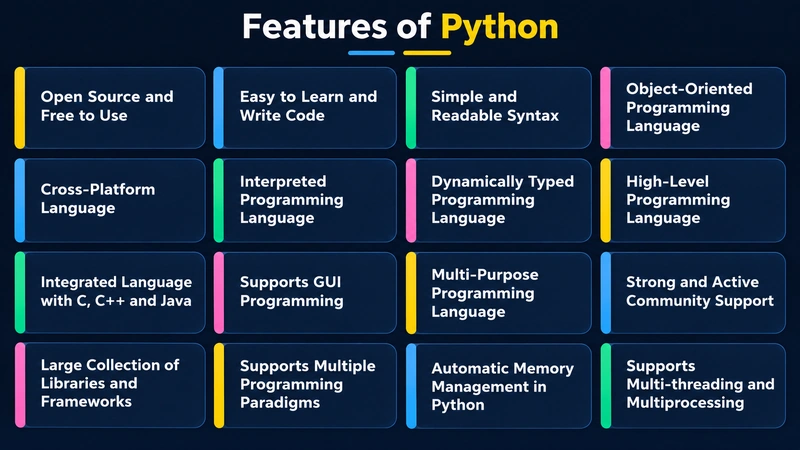
Open Source and free to use
Python is gratis. You can download it from the official website, python.org, install it on your computer and start writing code in minutes.
It is also open source . This means that the source code is available to the public . It can be learned, used, changed and shared by anyone. Python is the product of developers from all around the world . That collaborative effort is one of the main reasons why the language keeps evolving year after year
Easy to Learn and Write Code
Python is one of the greatest places to start if you are starting to program for the first time. The syntax is brief and comparable to normal English, so you spend less time wrestling symbols and more time learning how programming works
print("Welcome to NcodeScript Python Tutorial")Welcome to NcodeScript Python Tutorial
One line, and it works. In many other languages, the identical task requires a class, a main function and several lines of setup before anything displays on the screen.
Simple and Readable Syntax
Python code is easy to read, even if it was written by someone else. Python employs indentation to arrange code into blocks, rather than curly braces or semicolons. This enforces a tidy structure and makes programs look organized by default.
Let’s compare a little application that greets a user, in C++, and in Python.
#include <iostream>
using namespace std;

void welcome(string user) {
    cout << "Hi, " << user << "!" << endl;
}

int main() {
    welcome("Riya");
    return 0;
}Hi, Riya!
def welcome(user):
    print(f"Hi, {user}!")

welcome("Riya")Hi, Riya!
Both programs do the same task, but the Python version is substantially shorter and much easier to follow. Less boilerplate also means less possibility of making mistakes, and you’ll understand your code better when you come back to it later.
Object-Oriented Programming Language
Python is a fully object oriented programming language. In OOP you organize your application around objects. Each object is created from a class which is like a blueprint. The class determines what data ( attributes ) an object can have and what operations ( methods ) it can execute .
Think of a mobile phone. Its brand, model, colour and battery capacity are its attributes. Making a call, sending a message and taking a photo are its methods.
class Phone:
    def __init__(self, brand, model):
        self.brand = brand
        self.model = model

    def call(self, number):
        print(f"{self.brand} {self.model} is calling {number}")

my_phone = Phone("Samsung", "Galaxy S24")
my_phone.call("9876543210")Samsung Galaxy S24 is calling 9876543210
Python supports all the core OOP concepts, including encapsulation, inheritance, polymorphism and abstraction. These help you write reusable code and manage large projects more easily
Cross-Platform Language
Python is portable. A program you write on Windows will usually run on macOS, Linux or Unix without any changes. You only need Python installed on the system.
This makes Python a good choice for teams where workers are using diverse operating systems, and for software that must operate on many different kinds of equipment.
Interpreted Programming Language
Python is an interpreted language. You do not have to compile your full program before you can run it. Background: The Python interpreter turns your source code into an intermediate representation, called bytecode, which is subsequently executed by the Python Virtual Machine (PVM).
Debugging is significantly easier because the code runs step by step. If you have a mistake on line 8, Python stops executing on line 8 and gives you a nice error message. You may repair the problem immediately away instead of scouring the whole application.
Dynamically Typed Programming Language
In Python, you don’t have to declare the type of a variable. Python works out the type on its own when the program runs. This is called dynamic typing
score = 95
price = 49.99
city = "Jashpur"

print(type(score))
print(type(price))
print(type(city))<class 'int'> <class 'float'> <class 'str'>
We never told Python that score was an int or city was a str. That worked out by itself. This makes code concise and allows you to focus on logic, not type declarations.
High-Level Programming Language
Python is a high level language . This means it hides a lot of the low level aspects of the machine . No need to bother about system architecture, CPU registers, manual memory handling.
Instead, you express instructions in a human – friendly fashion, and Python does the rest . This means you may put your energy into the actual problem.
Integrated Language with C, C++ and Java
Python works well with other languages. You can connect Python code with C, C++ and Java, which is why it is often called an integrated or extensible language.
This is very useful in real projects. For example, a performance-heavy part of a program can be written in C or C++, while the rest is written in Python for speed of development. Many popular Python libraries, such as NumPy, use this approach to stay fast.
| Library | What it is good for |
Tkinter | Built into Python – Good for simple desktop apps |
PyQt / PySide | Qt framework based professional feature rich apps |
wxPython | Native apps for Windows, macOS, and Linux |
Kivy | Touch friendly apps for mobile, tablet and desktop |
Pygame | Interactive Multimedia Programs and 2D Games |
Multi-Purpose Programming Language
Python is a general purpose language so it is not restricted to any one field. You can also use the same language for:
- Web Development
- Data Science and DataAnalysis
- Artificial intelligence and machine learning
- Automation & Scripting
- Scientific research and calculations
- Desktop software & game development
Python is particularly powerful on the backend for developing websites with frameworks such as Django, Flask and FastAPI. Tools like PyScript even allow you to run Python inside HTML pages in the browser.
Strong, Active Community Support
Python boasts one of the largest communities of developers in the world. If you ever get stuck, help is at hand in the form of official documentation, online tutorials, forums, and Q&A sites such as Stack Overflow.
A big community means the language stays alive and relevant. Bugs are fixed rapidly, new tools are released often, and beginners can learn from the experience of millions of developers.
Large Collection of Libraries and Frameworks
This is one of Python’s biggest strengths. You rarely need to build anything from scratch.
Standard Library: Python ships with a large built-in library, often described as “batteries included”. Some useful modules are:
Task | Modules |
Working with files and folders | os, shutil, pathlib |
Handling data formats | csv, json, sqlite3 |
Maths and random numbers | math, statistics, random |
Networking | socket, urllib
|
Running tasks in parallel | threading, multiprocessing |
Third-party libraries: Thousands more packages are available through the Python Package Index (PyPI) and can be installed with a single pip command.
Field | Popular libraries and frameworks |
Data Science and AI | NumPy, Pandas, Matplotlib, Scikit-learn, TensorFlow, PyTorch |
Web Development | Django, Flask, FastAPI |
Automation and Web Scraping | Selenium, BeautifulSoup, Requests |
Testing | pytest, unittest |
These ready-made tools save time, reduce errors and let you build working applications much faster.
Supports Multiple Programming Models
Python doesn’t force you to program in a certain way. Supports many paradigms, which you can mix in the same project.
- Procedural programming: You write functions that describe step-by-step instructions.
- Object-oriented programming: You organize your code with classes and objects.
- Functional programming : You use functions like map(), filter() and lambda to process data without modifying it.
numbers = [1, 2, 3, 4, 5, 6]
even_squares = list(map(lambda n: n * n, filter(lambda n: n % 2 == 0, numbers)))
print(even_squares)[4, 16, 36]
This flexibility lets you choose the style that fits the problem best.
Automatic Memory Management in Python
In languages like C, programmers must allocate and free memory by hand, and a small mistake can crash the program. Python handles memory automatically.
Here is what happens behind the scenes:
- Memory allocation: when you create an object, Python reserves memory for it.
- Reference counting: Python keeps track of how many variables are using that object.
- Garbage collection: when nothing is using the object anymore, Python frees its memory automatically.
For example, in a shopping app, a cart object is created when a user adds an item. Once the user leaves and nothing refers to that cart, Python cleans it up on its own. You get safer code without extra effort.
Supports Multi-threading and Multiprocessing
Python can run more than one task at the same time, which is known as concurrency. It offers two main ways to do this:
- Multi-threading: runs several threads inside a single process. It works best for tasks that spend time waiting, such as downloading files, reading from a network or keeping a user interface responsive.
- Multiprocessing: runs separate processes, each with its own memory. It is the better choice for heavy CPU work like image processing, large data calculations and training machine learning models.
Conclusion
Python combines simplicity with real power. It is free, easy to read, runs on almost every platform and comes with a huge collection of libraries. Whether you want to build websites, analyse data, automate boring tasks or step into AI, Python gives you the tools to get started quickly and grow with confidence.