
Advantages and Disadvantages of Python
Advantages and disadvantages of Python are worth knowing before you choose it for your next project. Python is one of the most widely used programming languages today. Students pick it as their first language, startups use it to build products quickly, and large companies rely on it for web services, data science and artificial intelligence. Still, no language is perfect, and Python has a few weak points too.
Let’s look at both sides.
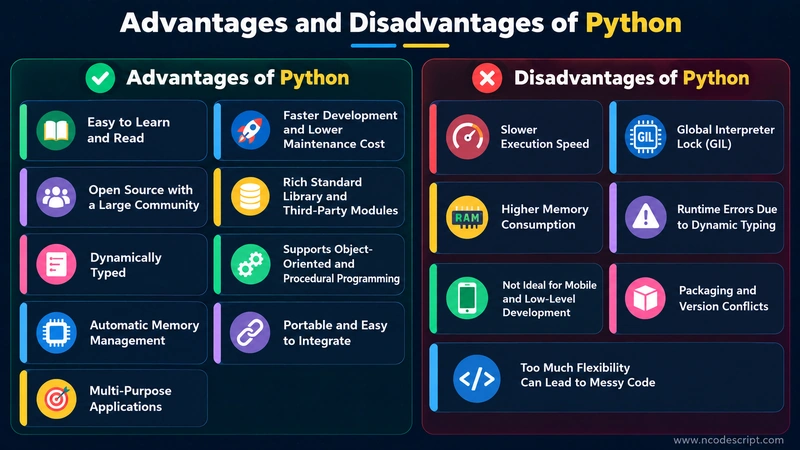
Advantages of Python
Easy to Learn and Read
Python’s syntax is short, clean and easy to learn. It uses indentation instead of curly braces to define code blocks. This makes programs look neat and easy to read. The novice can produce a working program on the first day . A veteran programr can read someone else ‘s code without too much trouble .
marks = [78, 85, 92]
average = sum(marks) / len(marks)
print("Average:", average)Average: 85.0
If you’ve never programd before you can probably guess what this code is doing.
Faster Development and Lower Maintenance Cost
Python requires fewer lines of code so developers are able to rapidly build and test ideas. Readable code is also easier to debug, update and to hand over to a new team member. This is why many companies choose Python for long-term projects as it saves time and money in the long run.
Open Source with a Large Community
Python is free and open source. You can download it, and use and share it at no cost. It also has a huge and active community that is writing tutorials , answering questions on forums and improving the language . If you’re ever stuck, a solution is only a search away.
Rich Standard Library and Third-Party Modules
Python has a large standard library to handle things like files, working with JSON and CSV, math and networking. In addition, the Python Package Index (PyPI) hosts thousands of third-party modules ready to be installed with a simple pip command.
Some common examples include:
- NumPy for Numerical Computations
- Pandas for data analysis
- Web Design with Django and Flask
- Machine Learning using TensorFlow , PyTorch
These out-of-the-box tools allow you to focus on the problem solving, instead of writing everything from scratch.
Dynamically Typed
In Python, you don’t have to declare the data type of a variable. Python decides the type automatically at the time of execution. It helps keep the code concise and flexible, particularly for small scripts and rapid experimentation.
Supports Object-Oriented and Procedural Programming
Python offers both object-oriented and procedure-oriented programming. Python also provides functional programming capabilities like map(), filter() and lambda. You can also mix them or choose the style that suits your project.
Automatic Memory Management
Python tracks memory and releases it automatically via reference counting and garbage collection. No need to release memory manually, so less danger of memory leaks and crashes.
Portable and Easy to Integrate
Python code executes the same on Windows, macOS and Linux. It also interfaces nicely with other languages like C, C++ and Java so that you may write performance essential bits in a faster language while the rest remains in Python.
Multi-Purpose Applications
Python fits almost every field, from web design and automation to data science, AI, scientific computing and scripting. Knowing one language opens up many career paths.
To explore each feature in detail, read our complete guide on Features of Python. |
Disadvantages of Python
Slower Execution Speed
Python is an interpreted language. Rather than compiling source code directly into machine code, the source code is compiled into bytecode, which is then run by the Python Virtual Machine. This is why Python is slower than compiled languages like C or C++.
This difference is not noticeable for most applications. Many programs spend more time waiting for files, databases, or network responses than doing heavy calculations. Libraries like NumPy and Pandas also do their heavy lifting in C, so data-heavy tasks remain fast. Or, extra speed can be attained by using implementations like PyPy.
Global Interpreter Lock (GIL)
The most popular implementation of Python , CPython , has a GIL ( Global Interpreter Lock ) . It only allows one thread to execute python code at a time . So multi-threading doesn’t give you a speed boost for CPU-heavy tasks.
The usual work around is to run multiple processes (multiprocessing) on multiple cores of the CPU. The standard version of Python still has the GIL, although recent versions of Python also have an experimental build without the GIL.
Higher Memory Consumption
Python’s flexibility comes at a price. Since everything in Python is an object with additional information attached, programs tend to use more memory than equivalent programs written in C or Java. This can be an issue when working with very large datasets or devices with limited memory.
Runtime Errors Due to Dynamic Typing
Dynamic typing is a benefit, but it comes with a cost. Some errors only pop up late because types are checked only when the program is running.
age = "25"
print(age + 5)
This code only throws a TypeError when that line is executed. In a statically typed language that error would be caught before the program runs. Tools such as mypy and type hints can help mitigate that risk.
Not Ideal for Mobile and Low-Level Development
Python is not the first choice for mobile apps, browser based front end development or low level system programming such as for operating systems and device drivers. Android is primarily Kotlin and Java, iOS is Swift, and system level work is generally C or C++. There are frameworks like kivy and beeware but they are less common.
Packaging and Version Conflicts
Python has a lot of packages, and sometimes managing them can be tricky. If different projects require different versions of the same library this can cause conflicts. Virtual environments (venv) is a great way to isolate dependencies for each project.
Too Much Flexibility Can Lead to Messy Code
Python allows developers a lot of freedom. This is great for rapid prototypes but without discipline large projects can become hard to read and maintain. The code is clean and consistent with coding standards such as PEP 8.
Conclusion
Python is a good choice for beginners and professionals alike, because it’s simple, has massive library support and a wide range of uses. The main drawbacks such as slower speed, the GIL and higher memory usage only matter in certain situations and most of them have practical solutions. Python remains a robust, dependable, and popular language for web design, automation, data science, and AI.